
Have you ever walked into a yarn shop telling yourself, “I’m only buying yarn for this one project”?
And then somehow you’re standing there 30 minutes later touching everything, comparing colors you definitely don’t need, and convincing yourself that yes, you absolutely have a future project for that gorgeous purple yarn. 😂
Yarn shopping is fun. Choosing the right yarn? That’s where things can get confusing.
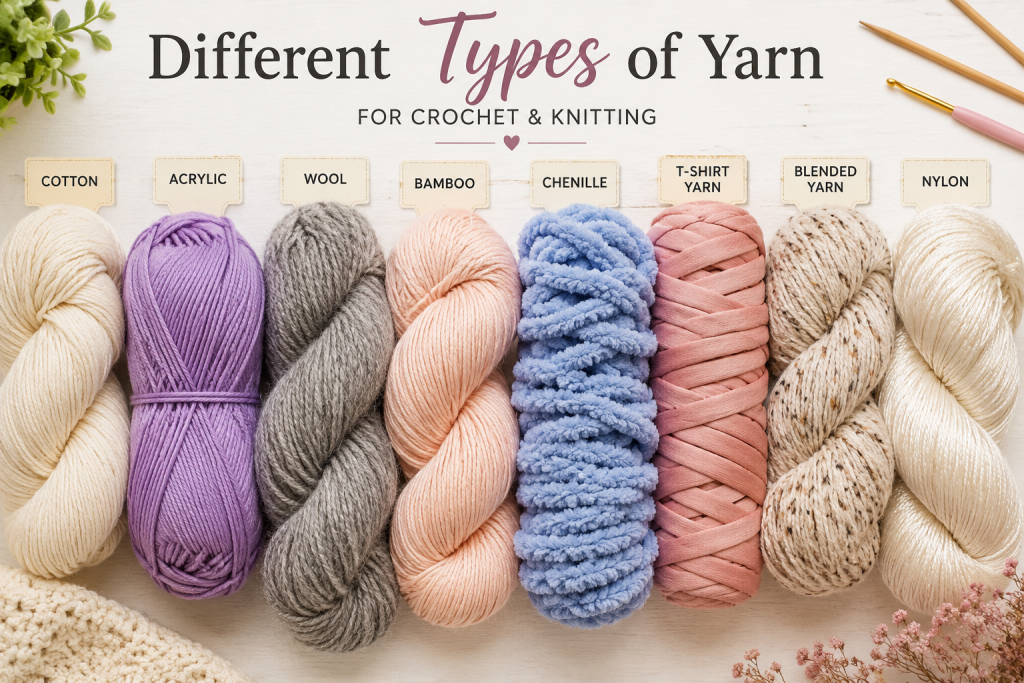
Cotton, acrylic, wool, bamboo, chenille, polyester… and then there are blends, different thicknesses, textures, and yarn labels that sometimes feel like they require their own instruction manual.
If you’re new to crochet, don’t worry. You don’t need to know everything about yarn before you pick up your hook.
But knowing a little about the different types of yarn for crochet can save you from discovering halfway through a project that the beautiful yarn you chose doesn’t actually behave the way you expected.
So, let’s talk yarn. 🧶
Different Types of Yarn for Crochet

Cotton Yarn | Acrylic Yarn | Wool Yarn | Bamboo Yarn | Nylon Yarn
First, Why Do Different Types of Yarn for Crochet Matter?
Because yarn isn’t just about color.
I know. Slightly disappointing considering how often we choose yarn because “LOOK AT THAT COLOR!” 😂
The fiber affects how your finished crochet project feels, stretches, drapes, holds its shape, and needs to be cared for.
Imagine making a structured crochet bag using an extremely soft, stretchy yarn. It might look gorgeous when you finish it, but once you put your phone, wallet, keys, and everything else in there, your cute little handbag may slowly become a shoulder-length grocery sack.
That’s why choosing yarn based on the project matters.
Let’s look at some of the different types of yarns for crochet you’re most likely to encounter.

Cotton Yarn: One of My Favorites for Crochet Bags
Let’s start with cotton because if you’re interested in crochet bags, you’ll probably see this one a lot.
Cotton is a natural fiber. It’s usually smooth, breathable, and wonderful at showing off your stitches.
And that last part is important.
When you’ve spent hours making a beautiful textured pattern, you actually want people to see those stitches.
Cotton works particularly well for crochet bags, market bags, coasters, placemats, dishcloths, amigurumi, summer tops, hats, and plenty of home décor projects.
It also tends to give crochet pieces a nice, clean appearance.
But cotton isn’t perfect.
It doesn’t have the same elasticity as something like wool, and a large cotton project can become surprisingly heavy.
That gorgeous oversized cotton bag?
Fill it with your phone, wallet, makeup pouch, charger, water bottle, three receipts from 2024 and whatever else has mysteriously been living inside your handbag…
Yeah. You’ll feel it. 😂
Acrylic Yarn: Affordable, Colorful and Beginner-Friendly
If cotton is one of the classics, acrylic is probably one of the yarns most beginners meet first.
And there’s a good reason for that.
Acrylic yarn is usually affordable, easy to find, and available in an enormous range of colors. It’s a synthetic fiber and is commonly used for blankets, scarves, hats, toys, decorations and everyday crochet projects.
It’s also a nice yarn to practice with, particularly if you choose a smooth variety.
One thing to remember, though: not all acrylic yarn feels the same.
Some inexpensive varieties can feel a little rough or scratchy, while others are incredibly soft. So if you tried acrylic once and hated it, don’t necessarily give up on the entire fiber.
Sometimes you just met the wrong skein. 😂
Wool Yarn: When You Want Something Warm and Cozy
Now let’s move into cozy territory.
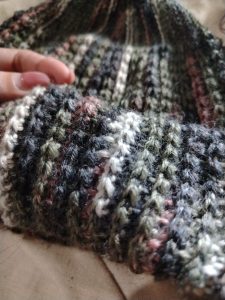
Wool is a natural animal fiber, most commonly made from sheep’s fleece. It’s warm, naturally elastic and wonderful for cold-weather projects.
Think sweaters, cardigans, scarves, beanies, mittens and warm blankets.
If you live somewhere hot and humid, a giant wool sweater probably isn’t going to become your everyday wardrobe staple. But wool is still worth knowing about, especially if you’re making items for people who live in cooler climates.
There are also different types of wool.
Merino, for example, is known for being much softer than some traditional wool varieties.
The downside is that wool can be more expensive, and some wool projects require careful washing. Certain varieties can also feel itchy against sensitive skin.
So before making an entire sweater, making a small swatch isn’t a bad idea.
Your neck will thank you later.
Bamboo Yarn: Soft, Smooth and Beautifully Drapey
The first thing you’ll probably notice about bamboo yarn is how it feels.
It’s often wonderfully soft and smooth, with a lovely drape.
That makes bamboo and bamboo-blend yarns particularly nice for shawls, lightweight tops, scarves, baby items and other projects where you want the fabric to flow rather than hold a stiff shape.
But that beautiful softness can also work against you if your project needs structure.
For example, if I’m choosing yarn for a crochet bag that needs to keep its shape, I wouldn’t automatically reach for the softest bamboo yarn on the shelf.
For a flowing summer top?
Now we’re talking.
Chenille Yarn: Fluffy, Adorable… and Occasionally Evil
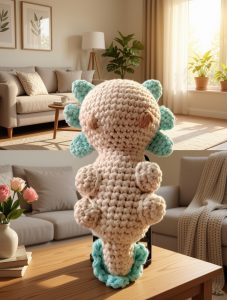
If you’ve seen those ridiculously cute chunky crochet animals online, there’s a good chance you’ve encountered chenille yarn.
Chenille is soft.
It’s fluffy.
It makes you want to touch it.
And then you start crocheting with it and suddenly realize…
WHERE ARE MY STITCHES?! 😂
Because chenille is so fluffy, the stitches can sometimes disappear into the yarn. That doesn’t mean beginners can’t use it, but it can be more challenging when you’re still learning where to insert your hook.
Chenille is wonderful for plushies, stuffed animals, cuddly blankets and pillows.
If you’re completely new to crochet, though, I’d learn your basic stitches using something smoother first.
You can fight the fluffy monster later.
Polyester Yarn: More Versatile Than You Might Think
Polyester is a synthetic fiber, and it appears in many different kinds of yarn.
Some polyester yarns are smooth. Others are plush and fluffy. You’ll often find polyester in blankets, stuffed toys, accessories, home décor and even certain types of crochet bags.
One of its biggest advantages is durability.
But because polyester yarns can vary so much, always check the label before deciding how you’ll use or wash one.
And yes, I know.
Checking yarn labels isn’t nearly as exciting as choosing colors.
Do it anyway. 😂
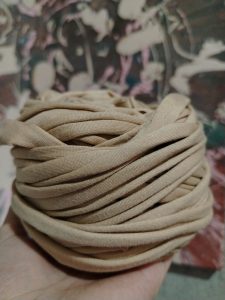
T-Shirt Yarn: When Regular Yarn Isn’t Chunky Enough
T-shirt yarn is exactly what it sounds like: thick strips of knitted fabric used like yarn.
And it’s FUN.
Because it’s so thick, your project grows much faster than it would with ordinary yarn.
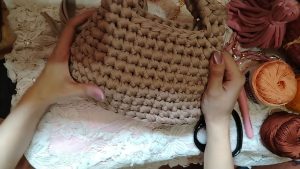
T-shirt yarn works especially well for baskets, rugs, storage containers and chunky crochet bags.
The trade-off is weight.
A large project made from T-shirt yarn can get heavy quickly, and you’ll usually need a much larger crochet hook.
But if you want a chunky, structured piece, it’s definitely something worth experimenting with.
Nylon Yarn: Small Fiber, Serious Strength
Nylon is known for durability, strength and elasticity.
You’ll often find it blended with other fibers rather than used completely on its own.
For example, adding nylon to another fiber can make the resulting yarn more resistant to wear. That’s why you’ll see nylon in some yarns intended for socks, bags and other projects that need to survive frequent use.
It might not be the first yarn a crochet beginner reaches for, but it’s useful to recognize when you’re reading fiber labels.
Blended Yarn: Sometimes You Don’t Have to Choose
Here’s where yarn gets really interesting.
A skein doesn’t necessarily have to be 100% cotton, wool, acrylic or anything else.
Manufacturers can combine fibers to get different characteristics from each one.
You might see:
Cotton + acrylic for a combination of cotton’s feel and stitch definition with characteristics from acrylic.
Wool + acrylic for warmth with potentially easier care or a lower price than pure wool.
Cotton + bamboo for something soft, breathable and beautifully drapey.
Wool + nylon when warmth, elasticity and durability are all important.
This is why reading the fiber content on the yarn label can tell you much more than simply looking at the yarn.
Wait… What About Yarn Weight?
Here’s something that confused me when I first started learning about yarn:
Fiber and yarn weight aren’t the same thing.
Cotton, wool, acrylic and bamboo tell you what the yarn is made from.
Yarn weight tells you roughly how thick the yarn is.
You’ll commonly encounter categories ranging from very thin lace yarn all the way to super bulky and jumbo yarn.
And naturally, the thickness affects your project.
Thicker yarn generally requires a larger hook and creates larger stitches, while thinner yarn typically uses a smaller hook and produces a finer fabric.
Your pattern should tell you what yarn weight and hook size it recommends, so don’t ignore that information and hope for the best.
Ask me how crocheters learn this lesson. 😂
So, What’s the Best Yarn for a Beginner?
If you’re learning crochet for the first time, I’d keep things simple.
Choose a smooth, medium-weight yarn in a color where you can clearly see your stitches.
Cotton or acrylic can both be good options depending on what you’re making.
And I wouldn’t recommend learning your first stitches using black fluffy chenille.
Can you do it?
Sure.
Should you?
Only if you enjoy unnecessary challenges. 😂
When you’re learning, being able to clearly see your loops and stitches makes everything easier.
Once your hands understand what they’re doing, that’s when you can start experimenting with all those fluffy, fuzzy and wonderfully weird yarns.
What’s the Best Yarn for Crochet Bags?
This deserves its own answer because not every bag needs the same yarn. Different yarn types work differently for different bags.
For a bag that needs structure and clearly defined stitches, cotton is one of the first options I’d consider. Cotton blends and some sturdy synthetic yarns can also work beautifully.
But don’t choose based on fiber alone.
Think about what the bag will actually be used for.
- Will it carry heavy items?
- Will you add a lining?
- Does the design need to hold its shape?
- Will the yarn stretch?
- How heavy will the bag become once it’s finished?
- Does it need to be washable?
A tiny evening bag and a large market tote have very different jobs, so it makes sense that they may need different yarns.
Natural Yarn vs. Synthetic Yarn: Which Is Better?
This is one of those questions where the answer is…
It depends.
I know. Very helpful. 😂
But there really isn’t one fiber that’s automatically better than everything else.
Natural fibers like cotton and wool have wonderful qualities. Synthetic fibers such as acrylic, polyester and nylon have their own advantages.
Instead of asking:
“What’s the best yarn?”
Try asking:
“What’s the best yarn for the thing I’m making?”
That one little change makes choosing yarn much easier.
Before You Buy That Beautiful Yarn…
Ask yourself a few questions.
- What am I making?
- Does it need to be soft or structured?
- Will it stretch?
- How will I wash it?
- What yarn weight does my pattern recommend?
And finally…
Do I actually have a project for this yarn?
Okay, fine.
We both know the answer to that last question doesn’t necessarily matter. 😂🧶
Sometimes you buy yarn because you need it.
Sometimes you buy yarn because it’s pretty.
And sometimes it sits beautifully in your stash for six months while you wait for it to tell you what it wants to become.
That’s part of the fun.
The Bottom Line for Different Types of Yarn for Crochet
There’s no single best type of yarn for crochet.
Cotton is wonderful when you want structure and beautiful stitch definition. Acrylic is affordable, versatile and beginner-friendly. Wool brings warmth and elasticity. Bamboo gives you softness and drape. Chenille creates incredibly cuddly projects. Polyester and nylon can offer durability, while blended yarns let you enjoy characteristics from several fibers at once.
The more you crochet, the more you’ll start noticing which yarns you naturally reach for.
And that’s something a yarn label can’t really teach you.
- You learn it by making things.
- You learn it when a yarn behaves completely differently from what you expected.
- You learn it when you finish something and think, “YES. This was the perfect yarn.”
And occasionally…
you learn it after frogging half a project.
We’ve all been there. 🧶💜
Frequently Asked Questions About Crochet Yarn
What type of yarn is easiest for beginners?
A smooth, medium-weight cotton or acrylic yarn in a light or medium color is usually easier to learn with because you can see individual stitches clearly.
Is cotton or acrylic better for crochet?
Neither is universally better. Cotton works beautifully for many bags, home items and summer projects, while acrylic is versatile, widely available and often more affordable. Choose according to what you’re making.
What yarn is best for crochet bags?
Cotton is a popular choice for crochet bags because it can provide good stitch definition and structure. Cotton blends and sturdy synthetic yarns can also be good choices depending on the design.
Can I use a different yarn than the one recommended in a crochet pattern?
Often, yes, but don’t substitute based on appearance alone. Compare yarn weight, fiber characteristics and gauge. Changing the yarn can change the size, drape, stretch and overall appearance of the finished project.
Can different types of yarn be used together?
Yes. Just remember that different fibers can stretch, shrink and react to washing differently. Try a swatch first when you’re unsure.