
Is Crochet Hard to Learn?
If you’ve ever watched someone crochet effortlessly while chatting, watching TV, or drinking coffee, you might have thought, “That looks relaxing. I could probably do that.”
Then you pick up a crochet hook for the first time.
Suddenly, the yarn won’t cooperate. Your fingers feel awkward. You’re not sure where the hook is supposed to go, and somehow the neat little square you were trying to make is beginning to look like a tiny misshapen potato.
So, is crochet hard to learn?
The short answer is no. Crochet is not especially hard to learn, but it can definitely feel difficult in the beginning.
Crochet is one of those skills where learning a few basic techniques can unlock a surprising number of projects. The challenging part is getting your hands, eyes, yarn, and crochet hook to cooperate long enough for those techniques to start feeling natural.
If you’re thinking about learning crochet, here’s what you can realistically expect.
Is Crochet Hard to Learn for Complete Beginners?
If you’ve never held a crochet hook before, you might assume that experienced crocheters possess some kind of magical hand coordination.
They don’t.
Most beginners can learn the basic mechanics of crochet fairly quickly. You don’t need special artistic talent, amazing hand coordination, or years of crafting experience.
However, there’s a difference between understanding how crochet works and actually feeling comfortable doing it.
You might understand how to make a chain stitch after watching a tutorial for five minutes, but getting every chain to look roughly the same size may take considerably longer.
That’s completely normal.
Think about learning to write when you were young. You understood that a pencil made marks on paper, but forming neat letters required practice.
Crochet works in a similar way.
Your hands are learning a completely new set of movements, and they need time to get used to them.
What Makes Crochet Feel Difficult at First?
It may feel awkward at first, and you’ll probably make some of the same mistakes every beginner makes. That’s completely normal.
Interestingly, the hardest part of learning crochet isn’t always the stitches.
For many beginners, it’s simply figuring out how to hold everything.
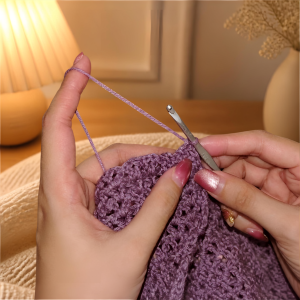
You have a crochet hook in one hand and yarn running through the other. One hand needs to move the hook while the other controls the yarn tension.
At first, it can feel like your hands have suddenly forgotten how hands are supposed to work.
You might grip the hook too tightly.
You might keep dropping the yarn.
Your stitches might become tighter and tighter until you can barely push the hook through them.
Or you may crochet so loosely that your project develops enormous gaps.
These aren’t signs that you’re bad at crochet. They’re simply part of developing muscle memory.
Eventually, your hands begin doing many of these movements automatically.
The First Crochet Skills You’ll Need to Learn
One reason crochet is relatively beginner-friendly is that you don’t have to learn dozens of techniques before making something useful.
Most beginners start with a handful of basic skills:
- Making a slip knot
- Holding the crochet hook comfortably
- Controlling yarn tension
- Creating a foundation chain
- Making basic stitches such as single crochet and double crochet
- Turning your work
- Counting stitches and rows
- Fastening off
- Weaving in yarn ends
Once you understand these basics, you can already begin making simple projects.
And that’s when crochet becomes much more exciting.
If you’re still wondering, “Is crochet hard to learn if I don’t know any of these things?” remember that nobody starts out knowing them. You learn them one at a time, not all in one afternoon.
The Real Beginner Struggle: Yarn Tension
If there’s one thing beginners tend to underestimate, it’s tension.
Tension refers to how tightly or loosely you hold and work the yarn.
If your tension is too tight, getting your hook into the stitches becomes difficult. If it’s too loose, your stitches may look uneven or floppy.
At first, you might constantly wonder whether you’re holding the yarn correctly.
The good news is that there isn’t one perfect way to hold yarn.
Experienced crocheters often develop their own comfortable method. The important thing is creating reasonably consistent tension.
Unfortunately, there isn’t a magical shortcut for this.
You develop tension through practice.
The more you crochet, the more your hands begin to understand how much pressure the yarn needs.
Counting Stitches Is More Important Than You Think
Here’s another beginner surprise.
Crochet involves a lot of counting.
You may start a row with 20 stitches and somehow finish the next row with 18.
Where did the other two go?
Welcome to one of the great mysteries of beginner crochet.
Usually, the stitches didn’t actually disappear. You probably skipped the first or last stitch of the row without realizing it.
The opposite can happen too. You accidentally crochet twice into one stitch and suddenly your rectangle begins getting wider.
This is why counting stitches is such an important beginner habit.
If you’re making something that’s supposed to have 20 stitches across, count them regularly instead of waiting until your project starts looking suspicious.
Stitch markers can also help you identify the beginning and end of rows or rounds.
Reading Crochet Patterns Can Feel Like Learning Another Language
Your first crochet pattern might look something like this:
Ch 21. Sc in 2nd ch from hook. Sc across. Ch 1, turn.
If you’ve never crocheted before, that probably looks less like crafting instructions and more like someone forgot half the letters.
Crochet patterns use abbreviations to keep instructions manageable.
For example:
ch = chain
sc = single crochet
dc = double crochet
sl st = slip stitch
st = stitch
You don’t need to memorize every crochet abbreviation immediately.
Start with the ones used in your current project. After following several patterns, you’ll begin recognizing common terms without thinking about them.
One important thing to remember is that US and UK crochet terminology can use different names for the same stitches, so always check which terminology a pattern uses before you begin.
That small detail can save you a surprising amount of confusion.
How Long Does It Take to Learn Crochet?
This is usually the next question that comes after “Is crochet hard to learn?”
Unfortunately, there isn’t one exact answer because everyone learns differently.
You might understand chains and basic stitches during your first afternoon of practice. It may take several days or weeks before your stitches become consistent.
Creating polished, complicated projects naturally takes longer.
A realistic beginner journey might look something like this:
Your first day
You’ll probably spend most of your time learning how to hold the hook and yarn, making chains, and wondering why your hands suddenly feel so awkward.
Your first few days
You can start practicing basic stitches and learning how to recognize where your hook should go.
You may also begin noticing the difference between stitches that are too tight, too loose, or just right.
Your first few weeks
You can begin making small projects, improving your tension, learning to count stitches, and becoming more comfortable reading simple patterns.
After a few months
You may feel comfortable experimenting with different yarns, stitches, shapes, and more complicated projects.
But crochet isn’t really something you completely finish learning.
Even experienced crocheters discover new stitches, techniques, patterns, and construction methods.
That’s part of what keeps it interesting.
What Is the Easiest Crochet Project for a Beginner?
Your first project doesn’t need to be impressive.
In fact, choosing something too complicated can make crochet seem much harder than it actually is.
Good first crochet projects include:
- Dishcloths
- Washcloths
- Simple scarves
- Coasters
- Basic headbands
- Small pouches
- Granny squares
These projects allow you to repeat the same stitches over and over, which is exactly what you need while developing muscle memory.
A rectangular project is especially useful because you’ll quickly notice if you’re accidentally adding or losing stitches.
And yes, your first rectangle might not actually be rectangular.
Keep it anyway.
Someday you’ll look at it and realize just how much your crochet has improved.
What Should Crochet Beginners Avoid?
You can technically choose any project you want, but some choices make learning unnecessarily frustrating.
For your first project, consider avoiding extremely fuzzy yarn because it can be difficult to see individual stitches.
Very dark yarn can also make stitches harder to identify, especially when you’re still learning where to insert your hook.
Tiny hooks and very thin yarn can require more precision too.
Instead, start with a smooth, light or medium-colored yarn that allows you to clearly see each stitch.
A medium-weight yarn paired with the hook size recommended on the yarn label is usually a comfortable place to begin.
Once you’re confident with the basics, you can experiment with all those gorgeous fluffy, chunky, delicate, sparkly, and wonderfully impractical yarns calling your name from the craft store.
Expect to Make Mistakes
If you’re asking “Is crochet hard to learn?” because your first attempt went badly, please don’t judge the entire craft by that first piece.
Your first crochet project probably won’t look like the photo that inspired you.
Your edges might wobble.
Your tension might change halfway through.
You may discover that you accidentally skipped three stitches ten rows ago.
You might even pull the entire thing apart and start again.
Crocheters call undoing stitches “frogging” because you “rip it, rip it.”
Yes, crochet has jokes.
Mistakes are actually incredibly useful when you’re learning because they teach you how crochet stitches are constructed.
Eventually, you’ll look at a strange section of your project and recognize exactly what happened.
That’s progress.
Don’t Compare Your First Project to Someone Else’s Hundredth
Social media can make crochet look deceptively easy.
You see beautiful bags, perfect granny squares, elaborate flowers, blankets with flawless edges, and adorable stuffed animals.
What you don’t always see are the years of practice behind them.
Every experienced crocheter once struggled with their first chain.
They’ve made uneven stitches.
They’ve miscounted rows.
They’ve followed the wrong section of a pattern.
They’ve probably stared at a project thinking, “Why does mine look nothing like the picture?”
Give yourself permission to be a beginner.
You don’t need your first project to be beautiful.
You simply need to make it.
Is Crochet Expensive to Learn?
Another nice thing about crochet is that the initial investment can be quite small.
You really only need:
- One crochet hook
- One ball or skein of suitable yarn
- A pair of scissors
- A yarn needle for weaving in ends
Stitch markers are helpful, but you can purchase those later.
Of course, crochet has a funny habit of turning “I’ll just buy one ball of yarn” into an entire shelf of yarn surprisingly quickly.
But technically, you can start very simply.
There’s no need to buy a complete collection of hooks, dozens of yarn colors, or expensive crochet accessories before you even know whether you enjoy the craft.
Is Crochet Easier If You Watch Videos?
For many beginners, yes.
Written instructions are useful, but crochet involves movements that can be difficult to understand from words alone.
Watching someone position the hook, wrap the yarn, and pull it through the loops can make a confusing instruction suddenly make sense.
When using crochet tutorials, don’t worry about matching the instructor’s speed.
Pause.
Rewind.
Watch the same five seconds several times if necessary.
You’re learning a physical skill, not racing the person in the video.
It can also help to find a crochet instructor whose teaching style works for you. One tutorial might leave you completely confused while another explains the same stitch in a way that suddenly clicks.
Is Crochet Worth Learning?
If you enjoy making things with your hands, absolutely.
Crochet can be practical, creative, relaxing, challenging, or all four depending on what you’re making.
You can create bags, clothing, blankets, flowers, home décor, accessories, toys, gifts, and countless other handmade pieces.
But one of my favorite things about crochet is the feeling of watching something slowly take shape.
You begin with yarn.
Just yarn.
Then one loop becomes another. A few stitches become a row. Rows become fabric.
Eventually, you’re holding something that didn’t exist before you decided to make it.
There’s something incredibly satisfying about that.
A Few Things You Might Be Wondering Before You Start
Before you buy your first hook and yarn, there are probably still a few little questions floating around in your head. Here are some of the ones beginners often have.
Can I really teach myself to crochet?
Absolutely. Many crocheters learn through videos, written tutorials, diagrams, and beginner patterns.
Videos can be especially helpful because you can pause, rewind, and watch the same movement as many times as you need.
Don’t feel like you have to understand everything after watching a tutorial once. Sometimes it takes seeing the same stitch demonstrated by a different person before it finally clicks.
What if I’m terrible at crafts?
You can still learn crochet.
Crochet is a skill, not something you either naturally have or don’t have.
Your first stitches may be uneven. Your first project might lean suspiciously to one side. None of that predicts how good you’ll eventually become.
Practice matters much more than natural crafting ability.
Can I actually learn crochet in one day?
You can definitely learn some of the basics in one day.
You might learn how to make a slip knot, foundation chain, and basic stitch during your first practice session.
That doesn’t mean you’ll be crocheting a complicated sweater by bedtime.
Give your hands time to learn.
Which crochet stitch should I learn first?
After learning how to make a foundation chain, single crochet is a great place to start.
It’s simple, useful, and gives you plenty of practice inserting your hook into stitches.
Once you’re comfortable with that movement, you can gradually add other stitches.
Why does my crochet keep getting smaller?
Ah, the mysteriously shrinking crochet project.
You’re probably losing stitches at the beginning or end of your rows.
Count your stitches after every row while you’re learning. Stitch markers can also help you identify the first and last stitches.
It might feel tedious at first, but it’s much less frustrating than realizing 15 rows later that your beautiful rectangle has quietly transformed into a triangle.
Do I need to be creative to enjoy crochet?
Not at all.
You can follow existing patterns exactly and still create beautiful handmade pieces.
You don’t have to design your own patterns or invent complicated color combinations.
And you may surprise yourself. Once you become comfortable crocheting, you might naturally start changing colors, combining stitches, adjusting patterns, or creating little details of your own.
So, Is Crochet Hard to Learn?
After all of that, we’re back to the original question: is crochet hard to learn?
Not really.
The basics are fairly approachable, but the beginning can feel awkward because your hands are learning movements they’ve never had to make before.
Your tension needs practice. Reading patterns takes some getting used to. Counting stitches will probably save you from several tiny crochet disasters.
But you don’t need to master everything before enjoying it.
Learn one stitch.
Practice it.
Make something small.
Make mistakes.
Undo a few rows.
Try again.
Eventually, you’ll notice that you’re no longer thinking about every movement. Your hands simply know what to do.
And that awkward little chain you struggled to make at the beginning?
It might just be the first stitch in a hobby you’ll love for years.
SEO Details
Focus Keyword: Is Crochet Hard to Learn?
SEO Title: Is Crochet Hard to Learn? What Beginners Should Expect
Meta Description: Is crochet hard to learn? Find out what beginners should really expect, from learning basic stitches and yarn tension to mistakes, first projects, and how long it takes to get comfortable with crochet.
Suggested URL Slug: is-crochet-hard-to-learn
Excerpt: Is crochet hard to learn? Not necessarily, but those first few stitches can feel surprisingly tricky. Learn what beginners should realistically expect, including common struggles, basic crochet skills, mistakes, and tips for choosing your first project.
Tags: crochet for beginners, learn crochet, beginner crochet, crochet tips, crochet basics, crochet mistakes, crochet projects, how to crochet, crochet learning guide, beginner crochet tips